
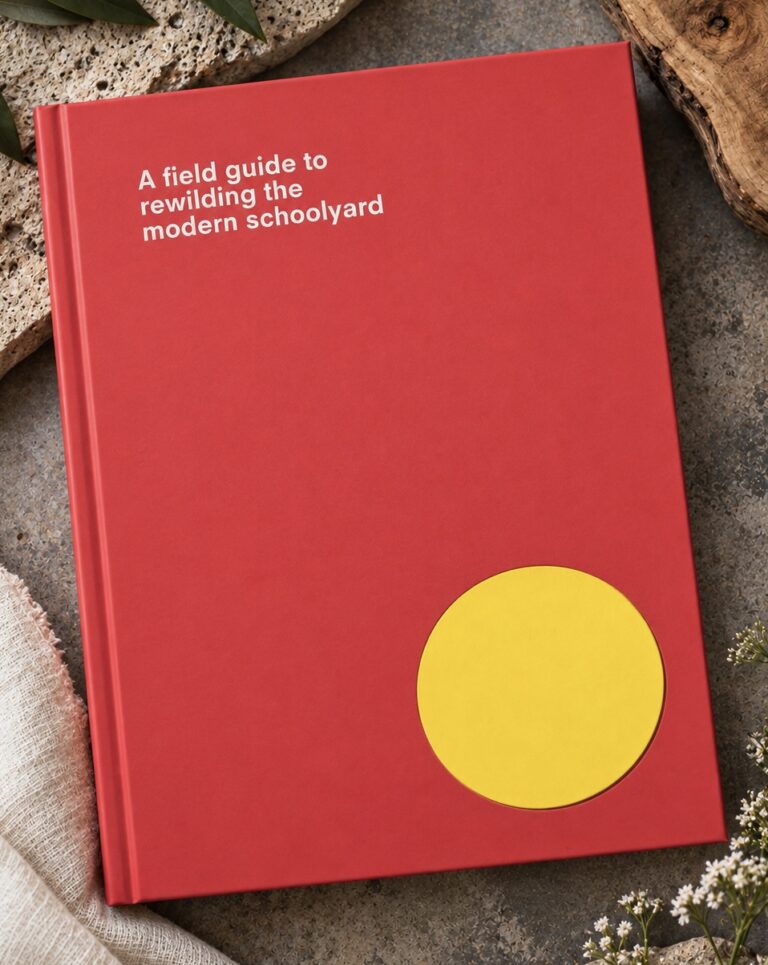
There are some projects that feel meaningful from the moment you encounter them. And then there are those that unexpectedly connect the past to the present in a way you could never have planned. A Field Guide to Rewilding the Modern Schoolyard, a book created by VS America and DLR Group, is one of those projects for me.
The book asks educators, parents, designers, and anyone who cares about children to reconsider one of the most familiar—and often overlooked—places in a child’s life: the schoolyard.
What if it were more than a place to burn off energy between classes? What if it were a place to listen, notice, wander, experiment, discover, and learn?
The book begins with wonderfully ordinary things: clover thick with bees, a stump worn smooth by small hands, maple leaves filtering sunlight. From there, it explores the connections between landscape and learning, play and possibility—drawing on research, stories, real-world examples, and the work of educators, ecologists, artists, and other changemakers.
Its larger argument is beautifully simple: perhaps rewilding the schoolyard can also help us rewild our idea of learning itself.
My father’s voice, decades later
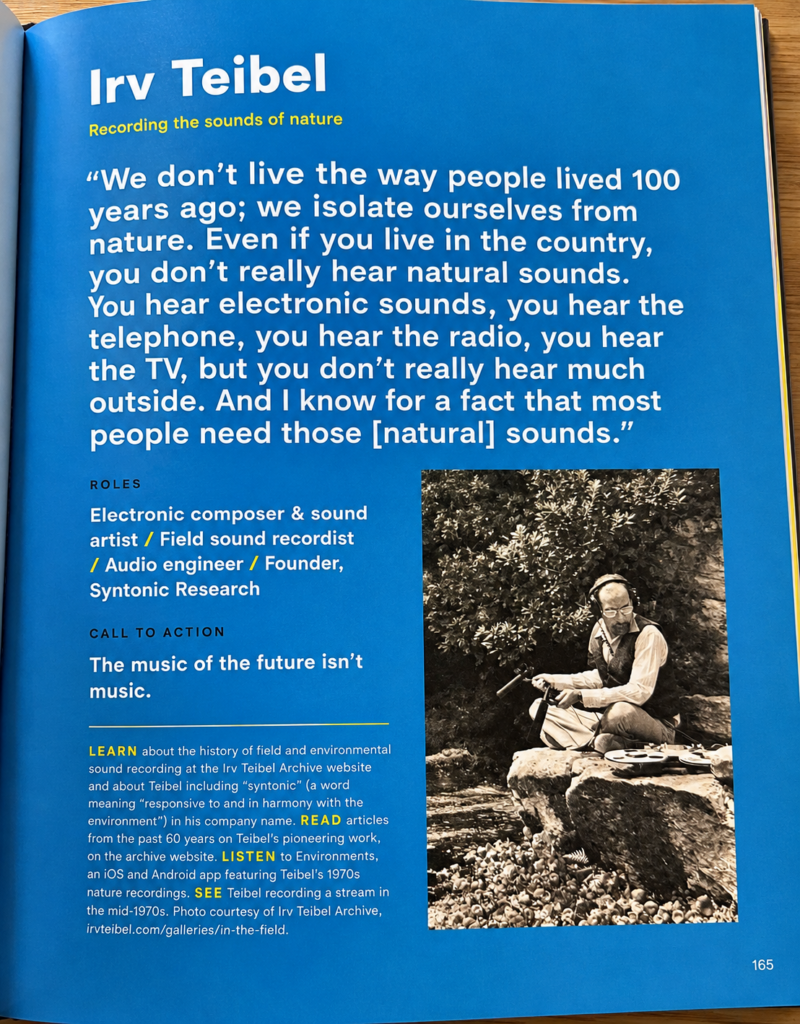
One of the people featured in the book is my father, Irv Teibel, the creator of the Environments series and founder of Syntonic Research.
Long before nature sounds became something we could summon instantly from a phone, my father was traveling with recording equipment, capturing oceans, streams, thunderstorms, birds, forests, and other natural environments. He wasn’t simply recording beautiful sounds. He was thinking about what happens to human beings when those sounds disappear from our everyday lives.
The book includes something he said decades ago: “We don’t live the way people lived 100 years ago; we isolate ourselves from nature.”
He went on to observe that even people living in the country were increasingly surrounded by electronic sounds—the telephone, radio, television—rather than truly hearing what was happening outside. And then he said something that feels remarkably current: “I know for a fact that most people need those [natural] sounds.”
Seeing those words in a book about the future of children’s learning stopped me.
His work was created in another era, with different technology and for a different audience. Yet the question underneath it hasn’t changed: What do we lose when we stop noticing the natural world around us?
From listening to learning
That question feels especially important when we think about children.
A Field Guide to Rewilding the Modern Schoolyard looks at what can happen when children are given room to encounter the unpredictable—to follow an ant trail, examine a dandelion seed, listen to birds, get curious about a tree, or simply wonder about something that wasn’t on the day’s lesson plan.
The book takes inspiration from Loris Malaguzzi’s vision of the school as a forest and brings together stories and artifacts spanning time, place, and disciplines. It includes field-practice cards designed to be taken outdoors, reflection prompts, activities for observing and sketching, and questions meant to spark conversations and workshops.
It’s not simply a book to read. It’s intended to move with you, live with you, and become a companion to discovery. And that may be what connects it most deeply to my father’s work.
He wanted people to listen again.
This book asks children—and the adults designing their worlds—to notice again.
A note I’ll keep
When the book arrived, D. Sorensen, one of its designers, included a handwritten note. She thanked me for contributing to the project and wrote that the book was “a testimony to your father’s legacy, the timelessness of his art, craft, and vision” and that “we hope this book brings joy and inspires continuous love of discovery.”
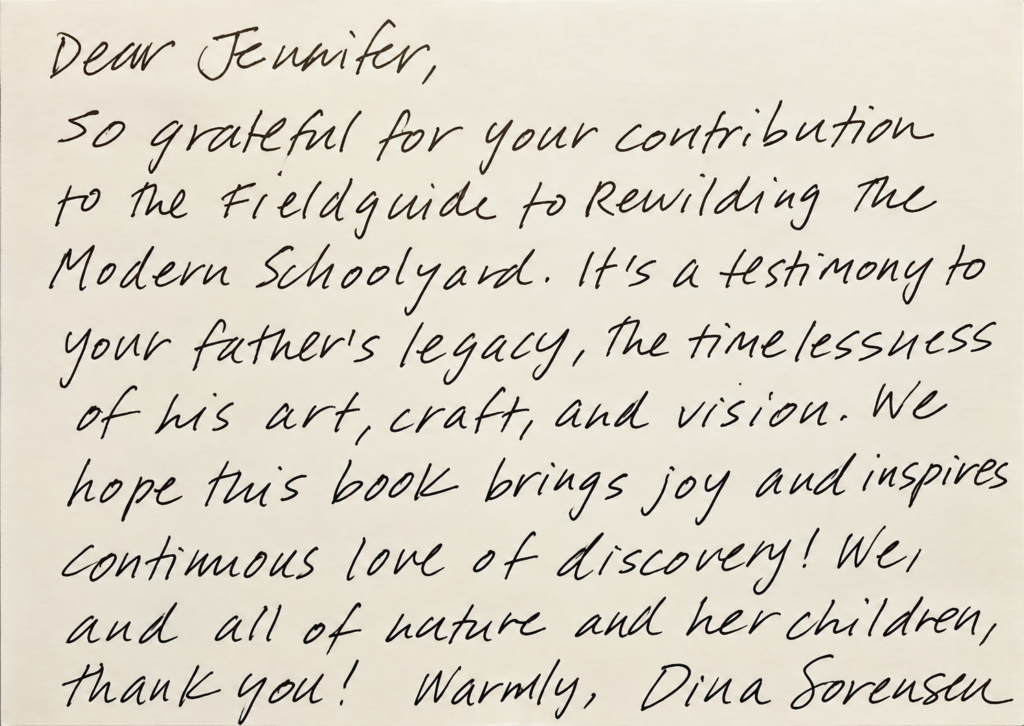
Those words meant a great deal to me. A legacy isn’t always carried forward in the way you expect. Sometimes an idea disappears for a while and then resurfaces somewhere entirely new.
My father recorded the natural world because he believed listening to it mattered. Decades later, that same belief has found its way into a field guide asking us to give children more opportunities to experience that world for themselves.
Listen. Notice. Wander. Discover.
Maybe those aren’t extras in childhood or education. Maybe they’re part of how we learn to be human.
About the book
A Field Guide to Rewilding the Modern Schoolyard was created by VS America and DLR Group and is credited to J. Ferkins, M. Lavezzo, L. Scott-Webber, and D. Sorensen (2025).
The book brings together research, stories, artifacts, field practices, reflection prompts, and examples from educators, ecologists, artists, and practitioners exploring nature and discovery in learning environments.
Readers are also invited to share pages, field-practice activities, and journal entries using #RewildingTheSchoolyard and tagging @VS_america on Instagram.